Go-To-Market Strategy
Go-To-Market Strategy Guide for Businesses: Hunter, Farmer, and Fisherman GTM Models Explained
Every successful business needs a clear go-to-market strategy—a systematic approach to reaching customers, generating revenue, and scaling operations. But not all GTM strategies work the same way. The path that drives explosive growth for one company might drain resources and stall momentum for another. Understanding which go-to-market model fits your business context makes the difference between predictable revenue growth and constant scrambling for the next deal.
Three distinct GTM strategy frameworks dominate modern business: the Hunter model, the Farmer model, and the Fisherman model. Each approach represents a fundamentally different philosophy about how to acquire and grow customer relationships. Hunters chase new opportunities (new logos) aggressively. Farmers cultivate existing accounts methodically. Fishermen create systems that attract the right customers naturally.
Most high-performing organizations don’t choose just one model. Instead, they blend elements from each framework based on market conditions, product maturity, customer segments, and growth objectives. A SaaS company might use fisherman tactics for mid-market acquisition, hunter strategies for enterprise accounts, and farmer approaches to expand existing customers. The key is knowing when and how to apply each model effectively.
What Is a Go-To-Market Strategy and Why It Matters
A go-to-market strategy defines how your company delivers value to customers and captures revenue in return. It’s the master plan that connects product development with customer acquisition, covering everything from market positioning and pricing to sales processes and customer success operations. Think of your GTM strategy as the blueprint that transforms your product or service into predictable revenue streams.
The importance of a well-designed Go To Market (GTM) framework becomes clear when you watch companies struggle without one. Teams work hard but point in different directions. Marketing generates leads that sales can’t convert. Product builds features nobody asked for. Customer success fights churn that could have been prevented. Revenue comes in spurts rather than steady streams. Everything feels reactive instead of strategic.
Companies with strong go-to-market strategies operate differently. Sales teams know exactly which prospects to pursue and how to engage them. Marketing creates content and campaigns that directly feed pipelines. Product development aligns with what customers actually need and will pay for. Everyone understands the path from awareness to advocacy, and they execute their part with precision.
Understanding the Three Core Go-To-Market Models
Before diving deep into each approach, it helps to understand the fundamental differences between Hunter, Farmer, and Fisherman GTM strategies. These models represent different philosophies about customer relationships, resource allocation, and growth mechanics.
The Hunter GTM strategy centers on aggressive outbound prospecting and new customer acquisition. Hunters identify target accounts, initiate contact through cold outreach, and pursue opportunities until they close or definitively die. This model thrives on activity metrics, persistence, and the ability to create opportunities where none existed before. It’s high-energy, high-effort, and typically high-cost, but it can penetrate markets quickly and generate revenue even when inbound demand doesn’t exist yet.
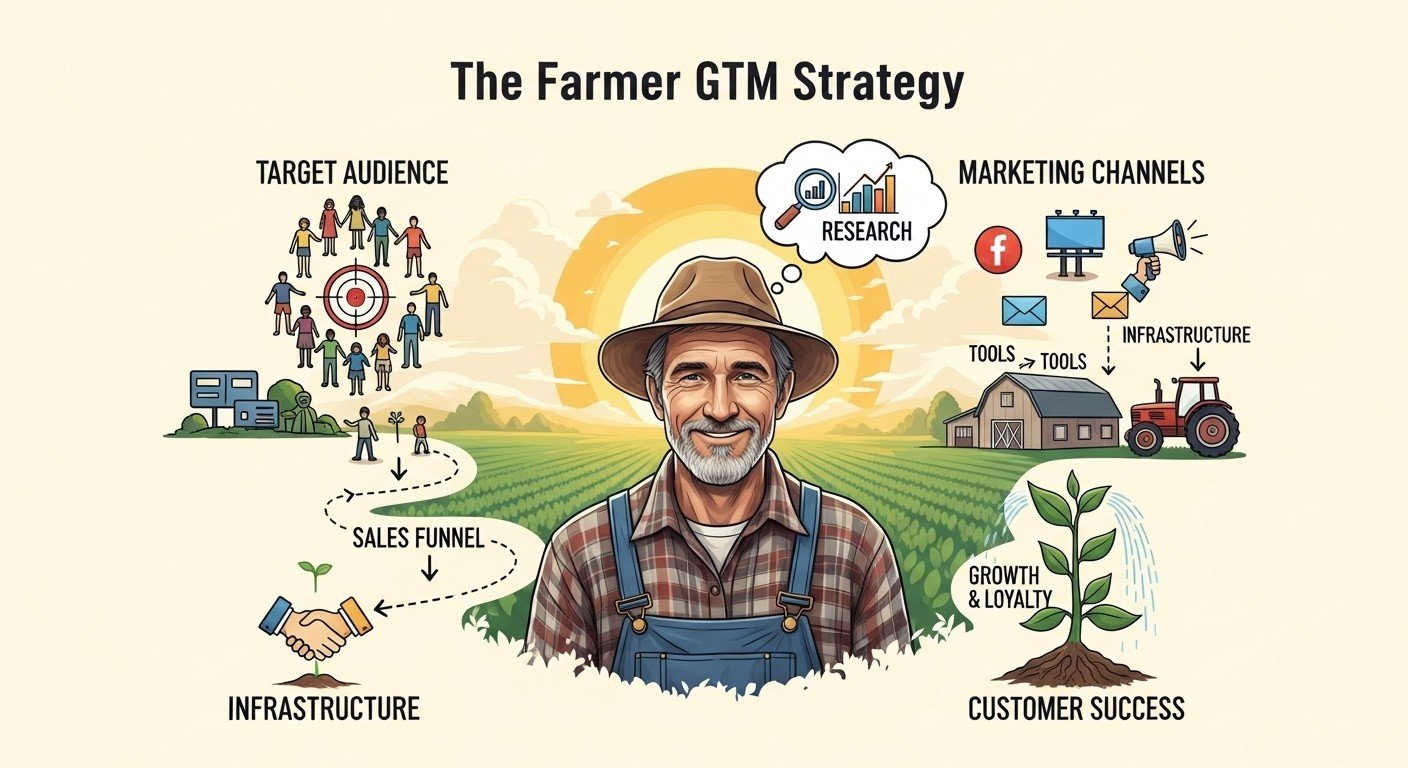
The Farmer GTM strategy focuses on cultivating existing customer relationships to maximize lifetime value. Farmers nurture accounts over time, identifying expansion opportunities, preventing churn, and turning satisfied customers into advocates who refer new business. This model excels at efficiency—the cost to expand an existing customer is typically one-fifth to one-tenth the cost of acquiring a new one. Farming works beautifully when you have a strong customer base and clear paths to upsell or cross-sell.
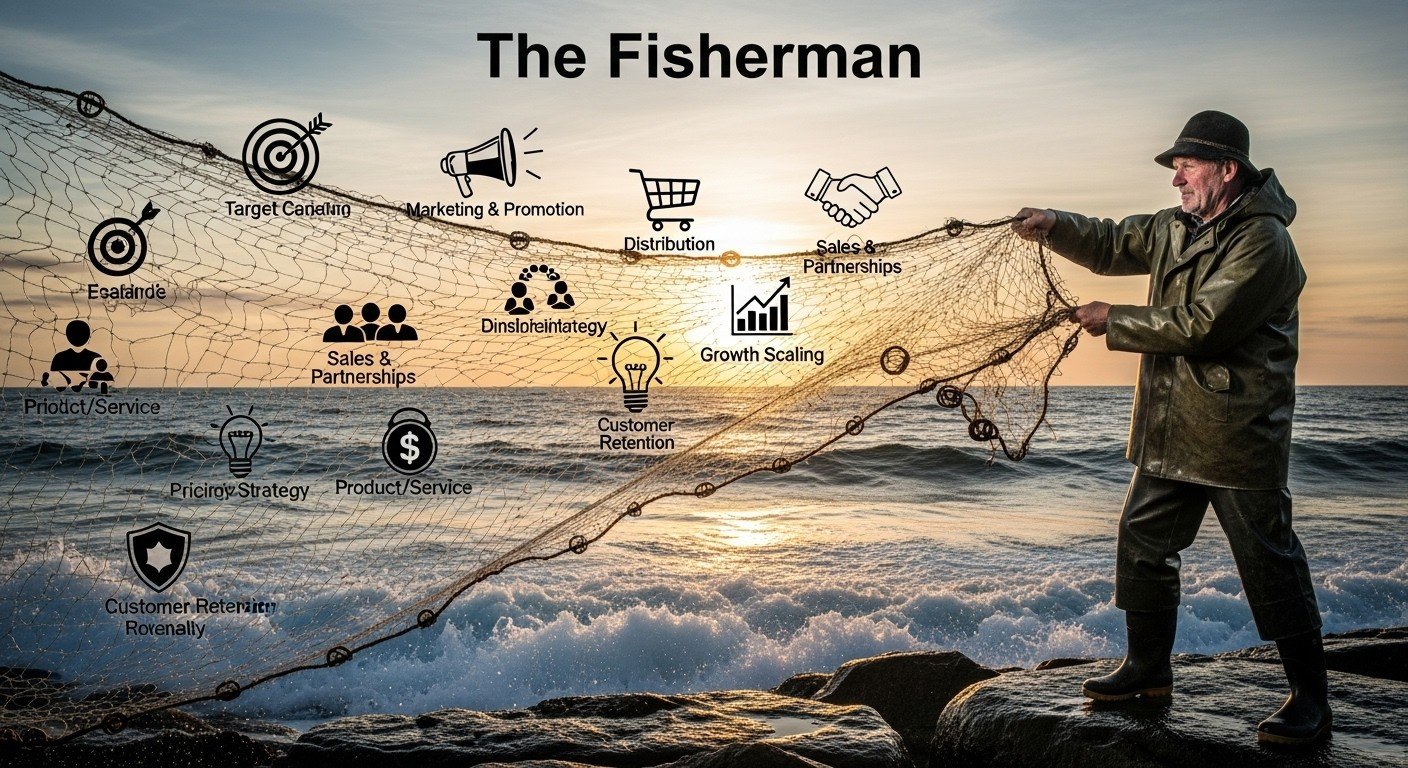
The Fisherman GTM strategy builds systems that attract ideal customers through inbound channels. Fishermen create valuable content, optimize for search engines, establish thought leadership, and position their solutions where buyers naturally look when researching options. Instead of interrupting prospects, this model integrates into their research process. The upfront investment is substantial, but the compounding returns create increasingly efficient customer acquisition over time.
Each model answers different questions.
- Hunters ask: how do we create demand where it doesn’t exist?
- Farmers ask: how do we maximize value from relationships we’ve already built?
- Fishermen ask: how do we position ourselves so that ideal customers find us when they’re ready to buy?
The answers lead to completely different resource allocations, team structures, and success metrics.
The Hunter GTM Strategy: Aggressive Outbound Acquisition
The Hunter go-to-market model operates on a simple but demanding premise: identify your ideal customers and pursue them relentlessly until they buy or clearly decline. This outbound GTM strategy doesn’t wait for prospects to come to you—it creates opportunities through proactive outreach, relationship building, and consultative selling.
What the Hunter GTM Strategy Looks Like in Practice
Picture a sales development team starting each Monday morning with a list of 50 target accounts. They’ve researched these companies, identified key decision-makers, and crafted personalized outreach. Throughout the week, they’ll send cold emails, make cold calls, engage on LinkedIn, and pursue meetings through any channel that works. When they connect with a prospect, the conversation focuses on understanding business challenges and positioning their solution as the answer.
The hunter approach feels active and energetic. There’s constant motion—dialing phones, sending messages, attending networking events, and asking for referrals. Sales leaders track activity metrics closely: calls made, emails sent, meetings booked, opportunities created. The assumption is that more activity generates more opportunities, which creates more revenue. Results correlate directly with the effort invested.
This model demands specific personality traits and skills. Successful hunters stay motivated through rejection—hearing No 95 times to get five conversations that produce one opportunity. They think strategically about account entry points, navigate complex organizations to reach decision-makers, and build relationships quickly with people they’ve never met. The psychological toll can be high, which is why hunter organizations often face turnover challenges.
Who Should Use the Hunter GTM Model
The Hunter GTM strategy works best in specific business contexts. Enterprise companies selling to large accounts with six or seven-figure deals almost always need hunter approaches. These sales cycles involve multiple stakeholders, long evaluation periods, and relationship-driven decisions. You can’t sit back and wait for a Fortune 500 company to discover your solution—you need to insert yourself into their consideration set through strategic outreach and persistence.
New market entry also demands hunter tactics. When launching a product category or entering a geographic market where you have zero brand recognition, inbound demand doesn’t exist yet. You need to create awareness and interest from scratch, which requires proactive outreach. Hunters excel at this initial market development work, building the first customer base that eventually enables other GTM models.
Highly customized or complex solutions often require hunter strategies because the value proposition isn’t obvious from marketing materials. When your solution addresses unique challenges or requires significant business transformation, prospects need consultative conversations to understand fit and value. Hunters provide this education and guidance, helping prospects see possibilities they hadn’t considered.
Key Performance Indicators (KPI) for Hunter GTM Success
Measuring hunter performance requires tracking both activity metrics and outcome metrics. Activity indicators include daily outbound touchpoints, accounts contacted, meetings booked, and opportunities created. These leading indicators predict future pipelines and help managers coach to specific behaviors that drive results.
Outcome metrics measure actual business results: pipeline generated, deals closed, average contract value, win rate, and sales cycle length. The relationship between activity and outcomes reveals efficiency. If someone makes twice as many calls but generates half as much pipeline, you have a quality problem, not a volume problem.
esponse rates at each stage of the outbound sequence show messaging effectiveness. What percentage of cold emails get opened? What percentage gets replies? What percentage of cold calls result in conversations? What percentage of first meetings advance tothe next steps? Each stage represents an opportunity to optimize.
Advantages and Challenges of the Hunter GTM Strategy
The Hunter model’s primary advantage is control. You decide which accounts to target, when to reach out, and how aggressively to pursue opportunities. This control enables rapid market entry, targeted account penetration, and the ability to generate revenue even when inbound demand doesn’t exist. If you need to hit specific revenue targets and can’t wait for organic growth, hunters provide a path forward.
Hunter strategies also build valuable market intelligence quickly. Every conversation teaches you something about customer needs, competitive positioning, and messaging effectiveness. This feedback accelerates product-market fit and helps you refine your entire go-to-market approach based on real market responses rather than assumptions.
The challenges are equally significant. Hunter GTM strategies scale linearly—double revenue requires roughly double headcount. This creates margin pressure and makes it difficult to achieve venture-scale growth without massive capital infusion. The model also suffers from diminishing returns as you exhaust the most accessible prospects and must work harder to engage remaining accounts.
The Farmer GTM Strategy: Cultivating Customer Lifetime Value
The Farmer go-to-market model focuses on maximizing value from existing customer relationships rather than constantly acquiring new ones. This GTM strategy treats each customer as a long-term asset to nurture, expand, and protect. Where hunters chase new logos and fishermen attract inbound prospects, farmers work the accounts they already have, growing revenue through upsells, cross-sells, and retention.
What the Farmer GTM Strategy Looks Like in Practice
Imagine a customer success manager reviewing their account portfolio on Monday morning. They’re tracking product usage metrics, looking for expansion signals, monitoring health scores, and identifying at-risk accounts. Throughout the week, they’ll conduct quarterly business reviews with strategic customers, introduce new product capabilities to accounts ready to upgrade, and intervene proactively when warning signs suggest potential churn.
The farming approach feels methodical and relationship-focused. There’s regular contact with existing customers—not to sell aggressively but to ensure success, identify opportunities, and solve problems before they escalate. Account managers know their customers deeply: business objectives, organizational dynamics, technology environment, and plans. This knowledge enables them to position expansions as natural next steps rather than transactional sales pitches.
Successful farmers think long-term. They’re willing to invest time helping customers succeed even when immediate revenue expansion isn’t on the table. They understand that a customer who achieves their goals with your product becomes a powerful advocate—providing referrals, case studies, and testimonials that support your broader go-to-market efforts. This patient’s value-first mindset differentiates farming from hunting.
Who Should Use the Farmer GTM Model
The Farmer GTM strategy thrives in subscription-based business models. SaaS companies with recurring revenue, managed service providers, and any business where customers make ongoing purchasing decisions benefit enormously from farming. When 80-90% of next year’s revenue comes from existing customers, investing heavily in those relationships makes obvious strategic sense.
Platform businesses with multiple products or modules are naturals for farming approaches. If customers typically start with one solution and can expand into adjacent offerings over time, farmer GTM strategies drive this expansion systematically. The initial sale represents a beachhead; farming activities turn that beachhead into a comprehensive platform adoption.
Enterprise GTM strategies often emphasize farming because large accounts offer massive expansion potential. A customer that starts with a $50,000 annual contract might grow to $500,000 or $5 million as they add users, expand to new departments, and adopt additional capabilities. Dedicated account management focused on driving this expansion creates enormous value.
Key Performance Indicators (KPIs) for Farmer GTM Success
Net revenue retention stands as the north star metric for farming success. This measures revenue growth from your existing customer base over time, accounting for upsells, cross-sells, downgrades, and churn. Companies with excellent farmer GTM strategies achieve net retention rates of 110-130%, meaning existing customers generate 10-30% more revenue year-over-year even without adding new logos.
Customer health scores predict which accounts are thriving and which need attention. Combine product usage data, support interaction patterns, payment history, and qualitative relationship strength into composite scores. Segment your customer base by health and track how accounts move between segments. Improving overall health distribution drives long-term value.
Expansion rate shows how effectively you’re growing existing accounts. Track what percentage of customers expand each quarter, average expansion deal size, and time from initial purchase to first expansion. These metrics reveal whether your expansion playbooks work and help you forecast revenue from existing customers more accurately.
Advantages and Challenges of the Farmer GTM Strategy
The Farmer model’s greatest strength is efficiency. Expanding existing customers costs one-fifth to one-tenth what acquiring new customers costs. You already have trust, demonstrated value, and established relationships. The marginal cost of adding users or capabilities to an existing account is minimal. This efficiency creates healthy margins and sustainable growth.
Farming strategies also generate compounding benefits over time. Happy customers provide referrals, reducing acquisition costs. Longer customer relationships mean more opportunities to expand. Deep customer knowledge enables better product development and positioning. The flywheel accelerates as your customer base matures.
Revenue predictability represents another major advantage. When most of next quarter’s revenue already sits in your customer base, forecasting becomes easier, and growth feels more controllable. This predictability enables confident investment in product development, market expansion, and team building.
The Fisherman GTM Strategy: Building Inbound Demand Engines
The Fisherman go-to-market model creates systems that attract ideal customers naturally through inbound channels. This inbound GTM strategy positions your company where prospects actively search for solutions, providing valuable content and resources that establish credibility and drive engagement. Instead of chasing prospects or cultivating existing relationships, fishermen build environments where the right fish swim to them.
What the Fisherman GTM Strategy Looks Like in Practice
Picture a content marketing team publishing comprehensive guides that answer the exact questions your ideal customers ask when researching solutions. These guides rank prominently in search engines, attracting thousands of qualified visitors monthly. Some visitors download additional resources by subscribing to your newsletter. Others start free trials. A percentage of requests for sales conversations. The prospects who arrive are already educated about their problem and interested in your solution category.
The fisherman’s approach feels strategic and patient. There’s a significant upfront investment in creating content assets, optimizing technical infrastructure, and building distribution channels. Results arrive slowly at first—search engines take months to rank new content, trust builds gradually, and flywheels need time to accelerate. But once the system starts working, it generates increasingly efficient returns that compound over time.
Successful fishermen think in terms of systems and assets rather than activities and transactions. They invest in content that drives value for years, not campaigns that end after 30 days. They optimize conversion paths that automatically qualify and route prospects. They measure efficiency and scalability over raw volume. This mindset shift from activity to systems represents the core of inbound thinking.
Who Should Use the Fisherman GTM Model
The Fisherman GTM strategy excels for SaaS go-to-market approaches, particularly for products with strong product-led growth potential. When prospects can understand your value proposition from content, try your product through self-service signup, and experience value quickly, the inbound model works beautifully. The content attracts prospects, the product converts them, and sales engage only when clear buying intent emerges.
Mid-market and SMB companies with defined ideal customer profiles benefit enormously from fisherman tactics. When you know exactly who you serve and can identify the questions they ask during research, creating targeted content becomes straightforward. The efficiency advantages matter especially for companies that can’t afford massive sales teams but need consistent new customer acquisition.
Competitive markets where buyers actively research and compare options create ideal conditions for fishing. If prospects naturally search for “solution A vs solution B” or “best tools for [use case],” you can position your company in those research paths. Being present with authoritative content when prospects make decisions gives you an enormous advantage.
Key Performance Indicators (KPIs) for Fisherman GTM Success
Organic traffic growth indicates whether your content is gaining visibility. Track overall traffic trends, but more importantly, segment by content type and user intent. Traffic to high-intent pages like product comparisons and pricing matters far more than traffic to general blog posts. Focus on attracting the right visitors, not just more visitors.
Conversion rates at each funnel stage reveal system health. What percentage of visitors become leads? What percentage of leads become qualified opportunities? What percentage of opportunities close? Track these rates overall and by traffic source. Declining conversion rates, even as traffic grows, signal quality issues that need addressing.
Keyword rankings for priority terms show whether your SEO strategy is working. Monitor position changes for your target queries and track how much traffic each ranking drives. Improving from position eight to position three for a high-volume keyword can double or triple traffic from that term.
Advantages and Challenges of the Fisherman GTM Strategy
The Fisherman model’s primary advantage is scalability withimprovedg economics. Content created once continues to generate traffic and leads for months or years. As your content library grows, internal linking strengthens, domain authority increases, and new content ranks faster. Marketing efficiency improves continuously rather than degrading, creating sustainable competitive advantages.
Inbound leads typically convert better than outbound prospects because they’re self-selected and educated. Someone who found your solution while researching their problem arrives with clear intent and context. Sales conversations start from understanding and interest rather than skepticism and resistance. This quality advantage shows up in higher win rates and shorter sales cycles.
The fisherman GTM strategy also builds brand equity and thought leadership that benefits your entire business. Consistently producing valuable content establishes you as an authority in your category. This credibility makes all GTM motions more effective—prospects trust you more, partners want to work with you, talent wants to join you, and media want to cover you.
Choosing the Right GTM Strategy for Your Business
The question isn’t which go-to-market model is best—it’s which combination of models fits your specific business context. Most successful companies operate hybrid GTM frameworks that blend hunter, farmer, and fisherman approaches in different proportions based on market segment, product maturity, and growth objectives.
Consider how the market segment influences model selection. Enterprise accounts with seven-figure contracts almost always require hunter strategies for initial acquisition. The sales cycle is too long, the deal too complex, and the competition too fierce to rely solely on inbound interest. But once you land that enterprise customer, farmer strategies drive expansion. Meanwhile, mid-market segments might respond beautifully to fisherman tactics supplemented by light hunter touches for strategic accounts.
Product maturity also shapes your GTM framework. In early stages, when you’re establishing product-market fit, hunter approaches help you learn quickly through direct prospect conversations. As your product matures and you understand buyer needs clearly, fisherman strategies become more viable because you know what content resonates. When your customer base reaches critical mass, farming delivers efficient growth through expansion.
Building Your Go-To-Market Strategy: Where to Start
Implementing an effective GTM framework requires an honest assessment of your current situation and a clear prioritization of what to build first. Start by documenting your existing go-to-market motions.
How do customers find you today?
Where does the pipeline come from?
What’s working and what isn’t?
This baseline understanding prevents you from abandoning effective approaches while pursuing new ones.
Next, analyze your ideal customer profile, deal economics, and competitive landscape. Who are you best positioned to serve? What can you afford to spend acquiring them? How do they currently research and buy solutions in your category? These insights guide which GTM models make strategic and financial sense for your business.
Choose one primary GTM motion to build initially rather than trying to execute all three simultaneously.
If you select a hunter, invest in building a high-quality prospecting machine with proper training, tools, and processes.
If you choose a fisherman, commit to creating genuinely excellent content and the technical infrastructure to distribute it.
If you focus on farming, implement the customer success systems needed to expand and retain effectively.
Set realistic timeframes and expectations. Hunter organizations need 3-6 months to build productive sales teams. Fisherman strategies require 6-12 months before inbound becomes a significant pipeline source. Farmer programs show results more quickly but need sufficient customer volume to justify investment. Understanding these timelines prevents premature abandonment of strategies that would have succeeded with more patience.
Your Path to Predictable Revenue Growth
Understanding Hunter, Farmer, and Fisherman GTM strategies gives you powerful frameworks for building predictable revenue engines. Each model offers distinct advantages for specific business contexts. Hunters create opportunities through aggressive outreach. Farmers maximize value from existing relationships. Fishermen build systems that attract ideal customers naturally.
The companies that win don’t choose just one approach. They blend elements from each model strategically, deploying hunter tactics where aggressive acquisition makes sense, farming where expansion opportunities exist, and fishing where inbound economics work. This hybrid approach creates resilient, diversified revenue streams that weather market changes and competitive pressure.
Your specific GTM strategy should reflect your market position, product characteristics, customer segments, and growth objectives. There’s no universal best practice—only best practices for your particular situation. The frameworks outlined here give you the vocabulary and concepts to make informed decisions about where to invest your limited resources for maximum impact.