Contact Info

A Great Product Without a GTM Strategy Is an Opportunity Wasted.

Businesses fail in the market not because their product is wrong but because their approach to the market is. A compelling offering launched without a disciplined go-to-market strategy reaches the wrong audiences, with the wrong message, through the wrong channels — and the opportunity that took months or years to build is squandered in the execution. Go-to-market consulting exists to prevent exactly that.

A well-designed GTM strategy defines precisely how a business will bring its product or service to market, who it will target, how it will position its value, and how it will convert market opportunity into revenue. Wael Salama works with companies preparing for launch, entering new markets, or repositioning existing offerings to build GTM strategies that are commercially sharp, operationally executable, and built to win.

Go-To-Market Strategy Development

The foundation of every GTM engagement is a clearly defined strategy that connects the product’s value to the right market, the right customer, and the right moment. This phase establishes the strategic logic of the entire go-to-market approach — target market selection, value proposition design, competitive positioning, and revenue model alignment.

A GTM strategy is not a launch checklist. It is a strategic document that answers the most important commercial questions before resources are committed and decisions become difficult to reverse. Getting this foundation right is the single most important factor in determining whether a market entry succeeds or stalls.

Market Opportunity & Readiness Assessment

Before entering a market, the opportunity must be understood with precision. This phase evaluates market size, demand dynamics, competitive density, customer readiness, and the structural barriers that could affect successful entry. It also assesses the business’s internal readiness — whether its product, team, operations, and financial model are prepared to execute the GTM strategy at the pace the market requires.

This assessment prevents the costly mistake of entering a market with either an overestimated opportunity or an underestimated execution challenge.

Target Audience & Ideal Customer Profile

Every effective GTM strategy is built around a precise definition of the ideal customer. This phase develops detailed ideal customer profiles — defining the characteristics, behaviors, needs, and decision-making processes of the audiences most likely to adopt the product, derive genuine value from it, and become long-term customers.

Targeting without this precision leads to diffuse messaging, inefficient sales processes, and marketing spend that reaches large audiences but converts poorly. A sharply defined ICP focuses every subsequent GTM decision — from messaging to channel selection to sales approach.

Value Proposition & Messaging Architecture

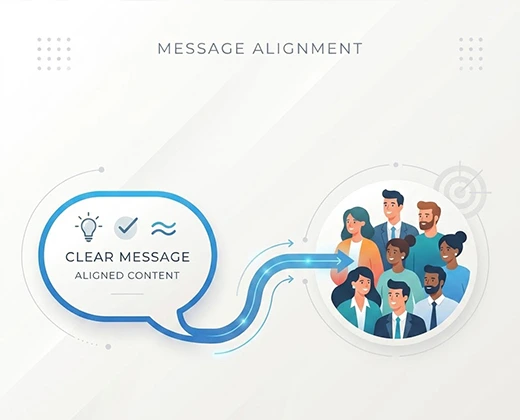
How a business communicates its value is as important as the value itself. This phase develops the core value proposition and messaging framework that will define how the offering is positioned across all GTM channels and customer touchpoints. The messaging is built to resonate specifically with each priority audience segment — addressing their most pressing challenges, speaking to their decision criteria, and differentiating the offering clearly from competitive alternatives.

Messaging architecture ensures consistency and strategic coherence across sales, marketing, and customer communications from day one.

Channel Strategy & Market Entry Planning

Reaching the right customers requires the right channels — and not all channels are equally suited to every market, product type, or customer profile. This phase defines the optimal mix of direct sales, digital marketing, partnerships, distribution, and content channels that will most efficiently reach and convert the target audience.

Channel strategy is evaluated against speed to market, cost efficiency, competitive dynamics, and the business’s internal capacity to execute. The output is a sequenced market entry plan that prioritizes the highest-impact routes to revenue first.

Sales Enablement & Revenue Model Alignment

A GTM strategy only delivers results if the sales function is equipped to execute it. This phase ensures that the sales team has the positioning clarity, messaging tools, objection-handling frameworks, and pipeline structure needed to convert GTM strategy into closed revenue.

Revenue model alignment ensures that pricing strategy, sales motion, and customer acquisition economics are coherent with the broader GTM approach — so that growth is not only achievable but financially sustainable from the earliest stages of market entry.

GTM Performance Metrics & Optimization

A GTM strategy is a living framework, not a fixed plan. This phase establishes the key performance indicators, feedback loops, and review cadences that allow the strategy to be measured accurately and refined continuously as real market data emerges.

The ability to learn quickly from early market signals and adjust the GTM approach accordingly is often the difference between a launch that builds momentum and one that loses it.

Launch With Clarity. Compete With Confidence.

The market will not wait for a business to figure out its strategy mid-launch. The companies that enter markets successfully are those that have done the strategic work before the first dollar is spent and the first customer is approached.

Working with Wael Salama, your business gets a go-to-market strategy built on rigorous analysis, commercial precision, and deep understanding of how markets actually respond to new entrants. Whether you are launching a new product, entering a new market, or repositioning an existing offering, the time to build your GTM strategy is now — before the window closes.

Don’t launch and hope. Launch with a strategy that’s built to win.