Loading...
“What if?”
What if there were a better way? What if I could turn this idea into a business? What if this problem could be solved differently?
Every business, product, service, and opportunity starts with a thought.
But a thought is not yet a business.
That’s where Thinking Out Loud comes in.
Too often, we jump from ideas to execution.
The goal isn’t to slow you down.
Good questions can save time, money, effort, and frustration.
And sometimes, they can turn an ordinary idea into a much better one.
Thinking Out Loud isn’t about telling you that your idea will work or won’t work.
It’s about exploring it.
An Entrepreneur With a New Idea
You have an idea but aren’t sure where to begin.
A Business Owner Looking for a New Direction
You want to expand, improve, or rethink part of your business.
Someone Thinking About Starting a Business
You've had an idea for years but haven't taken the first step.
A Problem Solver
You've identified a problem that nobody seems to be solving.
Then:
You don’t need a perfect business plan to start thinking.
You don’t need funding.
You don’t need everything figured out yet.
Start with the thought. Bring the idea. Let’s talk about it.
What’s Your Idea?
Maybe you’ve identified a problem. Maybe you’ve found a better way to do something. Maybe you’ve seen an opportunity others haven’t noticed.
“There has to be a better way.”
Questions:
What Problem Are You Solving?
Don’t start with the product.
Start with the problem.
Who has the problem? How are they solving it today? How often does it happen? What does it cost them?
Most importantly:
Do they care enough to solve it?
Who Will Pay for It?
“Everyone can use it” isn’t a target market.
Start with a specific customer.
Understanding the customer can change the entire direction of an idea.
Don’t Build Everything Yet.
One of the biggest mistakes entrepreneurs make is trying to build the finished product on day one.
Instead, ask:
What’s the simplest version we can test?
Talk to potential customers. Show them the concept. Create a basic version. Get feedback. Learn.
Test before you invest heavily.
An Idea Needs a Business Model.
Eventually, we need to answer some simple questions:
Who pays? What are they paying for? How much will they pay? How often will they pay? What does it cost to deliver?
A great idea needs more than customers.
It needs economics that make sense.
Build What You’ve Learned.
Once you’ve tested the idea, you can begin building.
Website. Product. App. Service. Brand. Marketing. Technology.
But now you’re building with information, not assumptions.
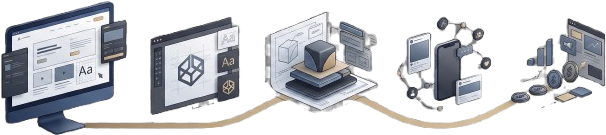
Think → Test → Learn → Build → Improve
Your First Version Doesn’t Have to Be Perfect.
Your business will change.
Your customers will teach you. Your market will change. Your competitors will change. Your original idea may change.
That’s okay.
Business is not a finished product. It’s an evolving process.
Progress often creates the clarity you were waiting for.
Sometimes You Don’t Need an Answer. You Need a Conversation.
Over the years, I’ve learned that entrepreneurs don’t always need someone to tell them what to do.
Sometimes they need someone to ask the right questions.
Use the questions as a visual list:
Why? Why now? Who needs this? What’s the real problem? What makes your solution different? How can we test it? What’s the next step?
That’s what Thinking Out Loud is about.
Ideas deserve to be explored before they’re judged.
And opportunities deserve to be tested before they’re abandoned.
Turn an idea into a clearer business opportunity and determine what to explore before investing heavily.
Explore new markets, products, services, customers, or growth opportunities.
Identify inefficiencies, rethink processes, and explore ways to operate more effectively.
Challenge assumptions, understand the opportunity, and determine whether an idea deserves further exploration.
Step back from the immediate issue and look at the problem from different perspectives.
When you know something needs to change but aren't sure what to do next, start with a conversation.
You don’t need to have everything figured out.
You don’t need a perfect business plan.
You don’t need to know exactly where you’ll be five years from now.
Bring the idea.
Let’s explore it. Let’s question it. Let’s challenge it. Let’s see what’s possible.
And if there’s something worth building, let’s figure out what comes next.